Verify FeedBuzzard’s traffic, pricing, and placement terms before launching a paid campaign.
Marketers use the phrase advertising FeedBuzzard when they want to know whether FeedBuzzard.com sells ads, sponsored posts, or other promotions. The clearest verified fact is that FeedBuzzard presents itself as a technology blog covering gadgets, global innovation, and wearable devices. Its Contact page accepts proposals, but the public pages reviewed do not show a conventional advertiser signup path, rate card, or media kit.
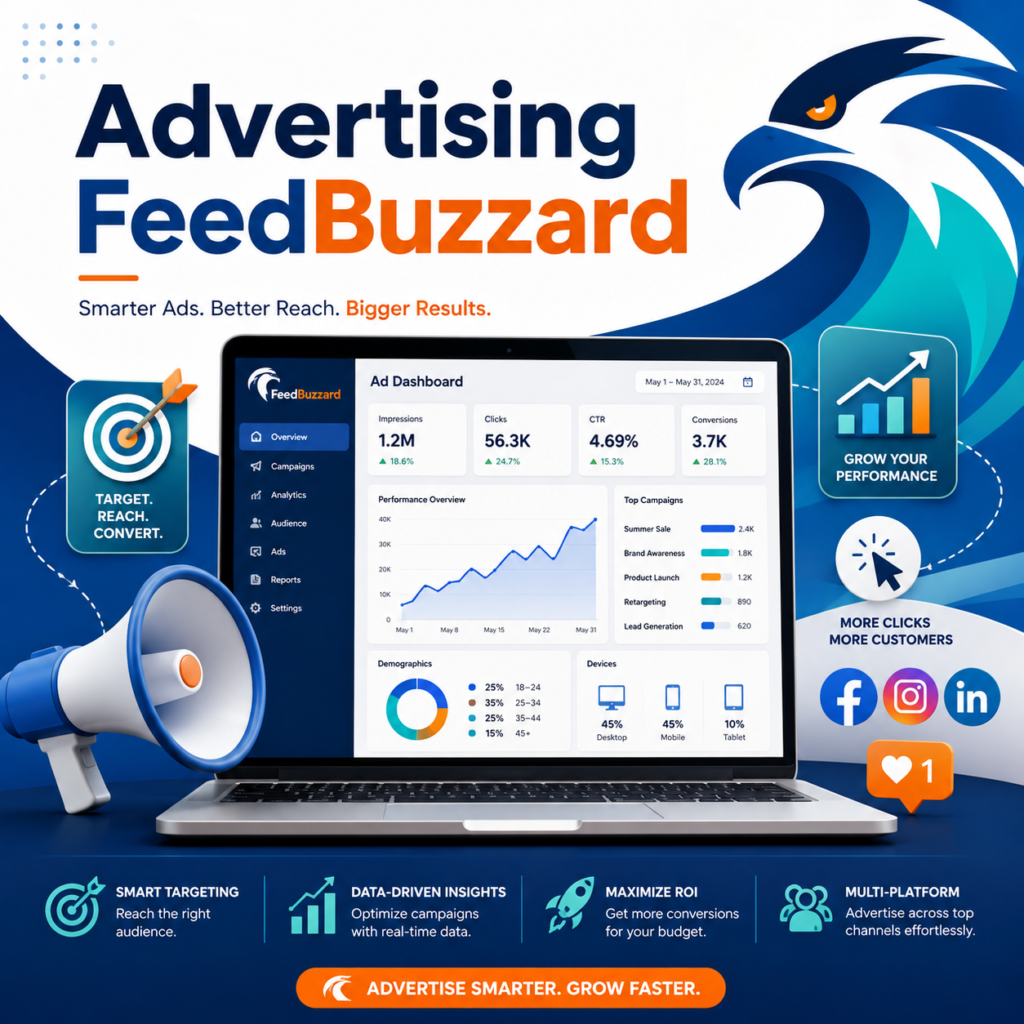
Several articles describe FeedBuzzard as a sophisticated advertising platform with targeting, bidding, dashboards, and campaign analytics. FeedBuzzard’s own advertising guide makes similar claims. However, public product documentation, pricing, audience figures, dashboard screenshots, and independently verifiable case studies do not support those claims.
Research note: We prepared this review on August 6, 2026. It compares FeedBuzzard’s About, Contact, homepage, privacy, and advertising pages with ranking articles and official advertising guidance. Its purpose is to help readers verify the opportunity before spending money.
What Is Advertising FeedBuzzard?
In practical terms, advertising FeedBuzzard most likely means arranging a paid placement on FeedBuzzard.com. That placement could be a sponsored article, banner, native-style promotion, or another publisher-led deal. Advertisers must confirm the exact options directly.
FeedBuzzard’s About page calls the website a blog for technology, global innovation, and wearables. Its Contact page asks users to send feedback or relevant proposals by email or form. This structure resembles a content publisher handling partnerships manually more than a fully documented self-service ad network.
Meanwhile, FeedBuzzard’s advertising content says advertisers can use native cards, banners, videos, sponsored articles, audience targeting, real-time bidding, and CPC, CPM, or CPI pricing. It also describes account creation, billing verification, conversion tracking, and campaign approval. These are site-published claims, and this review could not independently verify the features.
Therefore, the safest definition is simple: FeedBuzzard is a real content website with stated advertising ambitions, but its exact commercial system remains unclear from the public pages reviewed.
Why the Search Results Are Confusing
Results for this keyword often follow the same structure: definition, benefits, ad formats, account setup, targeting, pricing, analytics, and optimization. Some pages confidently tell readers to create an advertiser account. Others note the lack of visible onboarding, pricing, and proof.
This creates a clear content gap. Many ranking pages explain how an assumed platform should work instead of proving how FeedBuzzard actually works. A useful review must answer the questions that matter before payment:
- What placements are currently available?
- What does each placement cost?
- How much verified traffic will it receive?
- Which countries and devices make up the audience?
- How are clicks and conversions reported?
- What happens if the placement underdelivers?
What FeedBuzzard Publicly Claims to Offer
FeedBuzzard’s June 2026 guide describes native cards, banners, video spots, and sponsored articles. It claims placements may appear in feeds, articles, and mobile apps. The same page mentions demographic, interest, keyword, geographic, device, and lookalike targeting.
Those details sound similar to established ad-tech products. Still, public claims need supporting evidence. Before treating advertising FeedBuzzard as a programmatic platform, ask the publisher to demonstrate the system or share current screenshots after removing private data.
Verified Facts Versus Unverified Claims
| Topic | Publicly visible | Still needs confirmation |
|---|---|---|
| Website identity | A tech and wearable-content blog | Legal business and advertising-team details |
| Contact route | Public form and email | Dedicated advertising-sales process |
| Ad formats | Articles claim banners, native ads, video, and sponsored posts | Current inventory, sizes, availability, and examples |
| Pricing | CPC, CPM, and CPI are mentioned | Rates, minimum spend, fees, taxes, and refunds |
| Targeting | Audience and device targeting are claimed | Data sources, segment size, consent, and accuracy |
| Reporting | Analytics and tracking are claimed | Dashboard access, attribution rules, and report samples |
The table does not prove that a claimed feature is unavailable. It shows which details were visible and which require direct evidence.
How to Evaluate the Opportunity Before Paying
A publisher placement can work when its audience closely matches your offer. However, reach alone is not enough. You need evidence that the audience is relevant, human, and measurable.
Request a Current Media Kit
Ask for monthly page views, unique users, leading countries, device split, top content categories, newsletter size, and social reach. Request analytics screenshots with the reporting period visible.
Look for consistent traffic rather than one unusual spike. You should also ask which pages will display your promotion and how many views those pages typically receive.
Ask for Placement Examples
Request live examples of sponsored articles, banner positions, native units, and newsletter sponsorships. Check whether the site labels promotions clearly.
The US Federal Trade Commission says native advertising should not mislead readers about its commercial nature. When a disclosure is necessary, it should be clear, noticeable, and close to the advertising content.
Acceptable labels may include “Advertisement,” “Paid Advertisement,” or “Sponsored Advertising Content.” A vague label hidden at the bottom of an article may not provide enough transparency.
Confirm Link Treatment
Sellers should not market paid links as a way to pass ranking credit. Google recommends marking advertising or paid-placement links with rel="sponsored". The older nofollow attribute remains acceptable, although Google prefers the sponsored value for paid relationships.
Google also lists paid advertorial links that pass ranking credit as link spam. Its policies allow legitimate sponsorships, but publishers must qualify the links correctly.
A sponsored article can still produce referral traffic, brand exposure, product education, and leads. The risk begins when the main promise is an unqualified backlink designed to manipulate rankings.
Use Independent Tracking
Create a dedicated landing page and add UTM parameters to every campaign link. Google Analytics explains that campaign parameters can identify which ads or referral links send traffic to a website.
Track these results:
- Sessions from the placement
- Engaged visits
- Leads or purchases
- Conversion rate
- Cost per lead or sale
- Revenue from tracked conversions
Avoid judging success through impressions alone. A large impression number may look impressive while producing few meaningful visits.
Start With a Controlled Test
Use one placement, one offer, and one landing page. Set a fixed budget and stop date. Do not sign a long contract before you receive reliable performance data.
Put the agreement in writing. It should cover the publication date, placement duration, reporting method, revision limits, link attributes, refund conditions, content ownership, and removal policy.
Advertising FeedBuzzard vs Other Buying Options
| Option | Main strength | Main limitation | Best for |
| FeedBuzzard direct placement | Potential access to existing readers | Public pricing and workflow remain unclear | Small sponsored-content tests |
| Self-service ad network | Clear dashboards and scalable delivery | More setup and ongoing optimization | Performance campaigns |
| Specialist niche publisher | Strong topical relevance | Smaller audience and limited inventory | Qualified referral traffic |
| Sponsored-content marketplace | Easier publisher comparison | Quality varies; link offers can create SEO risk | Managed publisher outreach |
For most businesses, the best first question is not, “Which platform is cheapest?” Instead, ask, “Which option can prove access to people who may buy?”
Potential Advantages
Advertising FeedBuzzard could offer value when your product fits technology, software, online services, gadgets, or business tools. A relevant sponsored article can explain a complex offer more effectively than a small banner.
Direct publisher contact may also allow flexible copy, placement, campaign dates, and article length. For example, a software company could publish an educational guide showing how its tool solves a specific workflow problem.
A controlled campaign can also reveal which headline, offer, or landing page converts better. Even modest traffic may provide useful information for future advertising.
However, these advantages depend on verified audience quality and clear terms. They should not be assumed from promotional language.
Limitations and Warning Signs
The main limitation is transparency. This review found no public rate card, detailed media kit, dedicated advertiser portal, verified traffic report, or clearly documented refund policy on the main pages examined.
FeedBuzzard’s pages also make broad claims about targeting and campaign technology without enough visible documentation to assess them independently.
Pause the deal when a seller:
- Refuses to provide recent traffic evidence
- Guarantees rankings, sales, or a specific return
- Promises paid dofollow links as the main benefit
- Cannot show where the promotion will appear
- Requests payment through an irreversible method
- Avoids written reporting commitments
- Pressures you to pay before reviewing the terms
None of these signs proves wrongdoing alone. Together, though, they increase the risk of poor value or a payment dispute.
Is Advertising FeedBuzzard Worth It?
It may be worth a small test, but only after verification. Treat the opportunity as a direct publisher purchase until FeedBuzzard provides evidence of a functioning self-service advertising platform.
A sensible test has three conditions. First, the audience matches your offer. Second, the publisher provides verifiable reach and clear terms. Third, you can measure outcomes through your own analytics.
Skip the campaign when the purchase depends mainly on vague exposure, guaranteed SEO value, or unsupported audience claims.
ALSO READ: Advertise FeedBuzzard A Practical Guide for Businesses
Conclusion
The evidence best supports understanding advertising FeedBuzzard as a possible promotional relationship with FeedBuzzard.com, not automatically as a proven ad network.
The site publicly identifies itself as a technology-oriented blog and offers a contact route for proposals. It also publishes claims about advertising formats, audience targeting, bidding models, and analytics. Yet important commercial details remain unavailable or unverified on the public pages reviewed.
Before spending, request a current media kit, live examples, pricing, written terms, and a reporting sample. Then run a limited campaign with independent UTM tracking. That approach protects your budget while giving FeedBuzzard a fair chance to prove its value.
FAQs
What does advertising FeedBuzzard mean?
It usually refers to promoting a brand, product, service, or article through FeedBuzzard.com. The arrangement may involve sponsored content or another publisher placement, but advertisers should confirm the format and process directly.
Is FeedBuzzard a real website?
Yes. FeedBuzzard.com is an active content site that describes itself as a blog covering technology, innovation, and wearable gadgets. That confirms the site exists, but it does not verify every advertising feature claimed in its articles.
How much does FeedBuzzard advertising cost?
This August 6, 2026 review found no verified public price list. Although FeedBuzzard content mentions CPC, CPM, and CPI models, request a written quote stating the total cost, duration, placement, reporting, fees, and refund terms.
Does FeedBuzzard have an advertiser dashboard?
FeedBuzzard articles describe account creation, billing, campaign setup, and analytics. However, this review did not find a public signup flow or product documentation confirming the dashboard experience. Ask for a demonstration before paying.
Is a sponsored FeedBuzzard article good for SEO?
It can support awareness and referral traffic, but publishers should mark paid links with rel="sponsored" or nofollow. Buying links that pass ranking credit can violate Google’s spam policies. Evaluate the placement for audience value, not guaranteed rankings.
What should I ask before ordering?
Ask for verified traffic, audience countries, placement examples, rates, ad labeling, link attributes, publication timing, reporting, content ownership, removal rules, and refund terms. Put every promise in writing.
For more updates visit: Hiding Me