
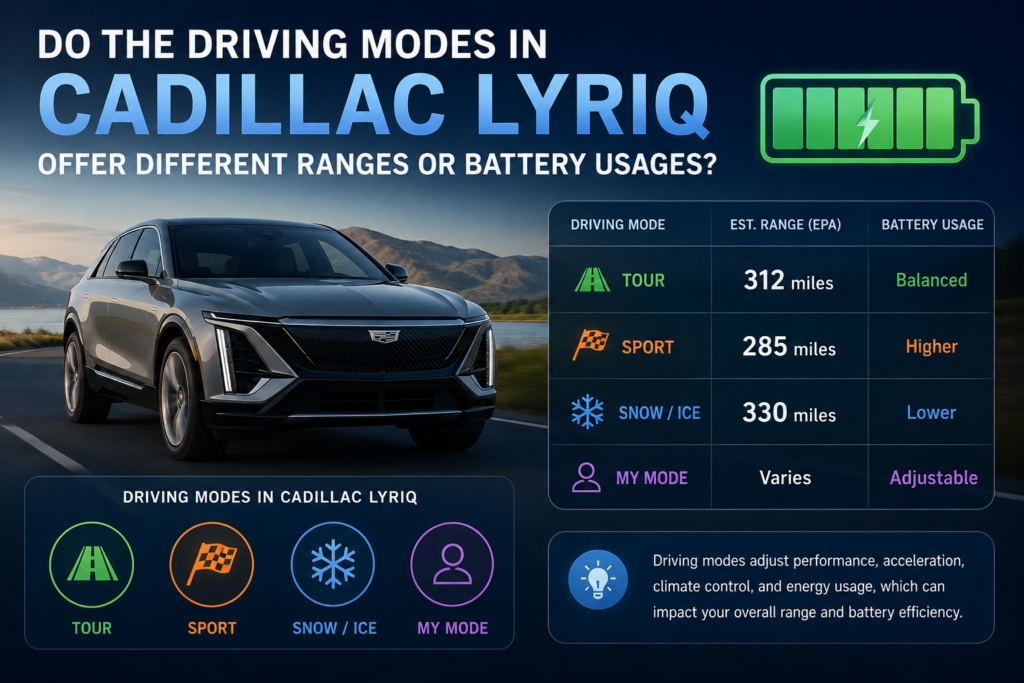
Cadillac LYRIQ driving modes and battery efficiency explained.
The Cadillac LYRIQ gives drivers several ways to change how the electric SUV responds. Tour feels smooth and relaxed, Sport sharpens the experience, Snow/Ice helps manage traction, and My Mode lets the driver personalize selected settings.
That naturally raises an important question: do the driving modes in Cadillac LYRIQ offer different ranges or battery usages?
The direct answer is yes, but only indirectly. Selecting a driving mode does not change the battery’s physical capacity or give the vehicle a separate official range rating. Instead, each mode changes settings such as accelerator response, steering feel, traction control and, on equipped versions, suspension behaviour. Those changes can influence how much electricity the vehicle uses in real-world driving.
Do Cadillac LYRIQ Driving Modes Change the Range?
Cadillac does not publish a separate EPA range estimate for Tour, Sport, Snow/Ice or My Mode. The official range depends primarily on the model year, drivetrain, equipment and wheel configuration—not simply the selected mode.
For the 2026 model year, Cadillac lists a 102-kWh-rated battery and up to 326 miles of EPA-estimated range for rear-wheel-drive LYRIQ models. That figure is a standardized estimate rather than a guarantee for every journey.
A driving mode can still affect the distance achieved from a charge because it changes how the vehicle reacts to the driver. Sport Mode may encourage stronger acceleration, while Tour Mode supports smoother everyday driving. The actual difference depends more on how the driver uses the mode than on the name of the setting itself.
In other words:
The mode changes the vehicle’s response, while driving behaviour determines much of the resulting energy consumption.
How Each LYRIQ Driving Mode May Affect Battery Usage
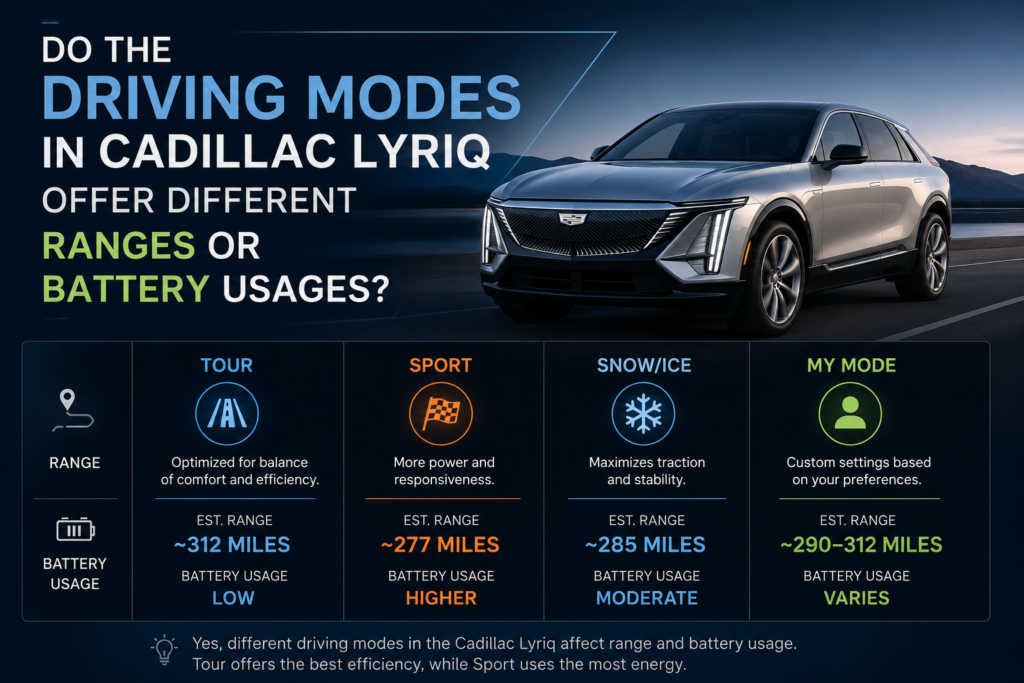
The available settings can vary by model year, trim and equipment. Standard LYRIQ models commonly offer Tour, Sport, Snow/Ice and My Mode. Performance-focused LYRIQ-V models add features such as V-Mode and Competitive Mode.
| Driving mode | Main purpose | Likely effect on energy use |
|---|---|---|
| Tour | Smooth, comfortable everyday driving | Usually the easiest mode for maintaining consistent efficiency |
| Sport | Sharper steering and enhanced responsiveness | May increase consumption when it leads to harder acceleration |
| Snow/Ice | Improved control on slippery roads | Energy use may rise because of cold weather, wheel slip and cabin heating |
| My Mode | Personalized steering, braking and acceleration settings | Depends on the settings selected and the driver’s behaviour |
| V-Mode | Maximum performance customization on LYRIQ-V | Can consume more energy during aggressive performance driving |
These are practical tendencies, not guaranteed range percentages. Cadillac does not claim that changing from Sport to Tour will always add a fixed number of miles.
Tour Mode: The Best Everyday Choice for Efficiency
Tour is the LYRIQ’s normal everyday driving mode. Cadillac describes it as providing normal acceleration and comfortable ride tuning. Its broader Driver Mode Control guidance also says Tour or Normal Mode is designed to optimize driving quality and economy.
Tour Mode does not place a strict limit on power. The LYRIQ can still accelerate quickly when needed. However, its calmer response can make it easier to:
- Accelerate gradually
- Maintain a steady speed
- Avoid unnecessary power surges
- Drive smoothly in urban traffic
- Reduce repeated acceleration and braking
These habits generally support lower electricity consumption.
For a daily commute, Tour is usually the most sensible default. It provides the comfort expected from a Cadillac without encouraging the sharper inputs associated with performance driving.
Sport Mode: Does It Use More Battery?
Sport Mode sharpens the driving experience. Cadillac says it provides enhanced responsiveness and tighter steering behaviour. Some equipped vehicles may also use a more noticeable propulsion sound or firmer suspension calibration.
Sport Mode does not automatically drain the battery at a dramatically faster rate. If the driver maintains the same speed and uses the accelerator gently, the difference may be small.
The greater consumption usually appears when the driver takes advantage of the sharper response by:
- Accelerating harder
- Reaching higher speeds
- Changing speed frequently
- Using more of the available motor output
- Driving aggressively on winding roads
Rapid acceleration requires a large amount of power over a short period. Although regenerative braking can recover some energy later, it cannot return every unit of electricity used during acceleration.
Sport Mode should therefore be viewed as a responsiveness setting, not as a fixed “high battery usage” switch.
Snow/Ice Mode: Weather Matters More Than the Mode
Snow/Ice Mode changes accelerator tuning to improve traction on slippery surfaces. Cadillac explains that the mode reduces or manages acceleration response to help prevent wheel slip.
That gentler response might sound efficient, but winter driving often reduces EV range for other reasons:
- Cold batteries operate less efficiently
- The cabin heater draws energy
- Battery conditioning may require power
- Snow and slush create rolling resistance
- Winter tyres may increase energy consumption
- Low grip can cause wheel slip
- Dense cold air increases aerodynamic drag
As a result, drivers may see higher battery usage while Snow/Ice Mode is active. The mode itself is not necessarily the main cause. The weather and road conditions are usually more important.
Cadillac also advises preheating or cooling the cabin while the LYRIQ is connected to external power when possible. This allows the vehicle to use electricity from the charging source rather than relying entirely on the battery after departure.
My Mode: Efficiency Depends on Your Settings
My Mode lets the driver personalize features such as acceleration feel, brake feel, steering response and motor sound. The exact options depend on the vehicle’s configuration.
Because My Mode is customizable, it does not have one predictable effect on range.
A comfort-focused configuration with smooth accelerator response may behave similarly to Tour Mode. A performance-oriented setup with sharp acceleration and firm responses may encourage greater energy consumption.
For better efficiency in My Mode, choose settings that support:
- Progressive accelerator response
- Smooth braking
- Predictable steering
- Moderate speeds
- Minimal unnecessary performance effects
The motor sound setting may affect the driving atmosphere, but propulsion demand, vehicle speed and climate use are much more important to overall battery consumption.
Regenerative Braking and One-Pedal Driving
Driving modes should not be confused with regenerative braking settings.
Regenerative braking slows the vehicle by using the electric motors as generators. Some of the vehicle’s kinetic energy is converted into electricity and returned to the battery. Cadillac’s LYRIQ guidance states that Regen on Demand can recover energy from the vehicle’s momentum for later use.
One-Pedal Driving can also reduce the need to move constantly between the accelerator and brake pedals. When the driver lifts off the accelerator, the vehicle slows while capturing some energy.
However, regeneration is not perfectly efficient. The best way to save energy is still to avoid wasting it in the first place. Smooth anticipation is generally better than accelerating hard and depending on regeneration to recover the loss.
Cadillac warns that One-Pedal Driving may not be suitable in slippery conditions such as wet, snowy or icy roads. Drivers should follow the owner’s manual and choose settings appropriate for current conditions.
What Has the Biggest Effect on LYRIQ Range?
The selected driving mode is only one part of the efficiency equation. Several other factors can have a much greater effect.
Vehicle speed
Energy consumption normally rises at higher speeds because aerodynamic resistance increases. A steady moderate speed is usually more efficient than fast highway driving.
Acceleration style
Repeated full-power acceleration draws more electricity. Smooth acceleration is one of the simplest ways to protect real-world range.
Cabin temperature
Heating and air conditioning use battery power. Heating can have a particularly noticeable effect during cold weather.
Outside temperature
Very hot or cold conditions can require the vehicle to manage battery temperature. Cold conditions may also reduce the amount of energy immediately available.
Wheels and tyres
Larger wheels, tyre design, tyre pressure and rolling resistance can affect range. Drivers should compare official estimates for their exact configuration.
Passengers and cargo
Additional weight requires more energy during acceleration and uphill driving.
Elevation and wind
Steep climbs, strong headwinds and exposed highways can increase electricity consumption. Downhill driving may recover some energy, but it will not fully cancel the energy used during the climb.
Can You Get More Range by Staying in Tour Mode?
Tour Mode is a sensible choice for efficient daily driving, but selecting it alone will not guarantee maximum range.
A driver using Tour Mode at high speed with strong acceleration may consume more electricity than a careful driver using Sport Mode gently. The setting influences response, but the driver still controls speed and power demand.
For the best chance of extending range:
- Use Tour Mode for normal journeys.
- Accelerate smoothly and anticipate traffic.
- Keep tyres at the recommended pressure.
- Precondition the cabin while plugged in.
- Use seat heating when appropriate instead of overheating the entire cabin.
- Remove unnecessary heavy cargo.
- Reduce speed when safely possible.
- Use regenerative braking smoothly.
- Check the vehicle’s recent efficiency display.
- Plan charging stops with a comfortable safety margin.
Do the Modes Affect Long-Term Battery Health?
There is no clear evidence that simply selecting Tour or Sport Mode causes unusual battery degradation.
Long-term battery condition is influenced by many factors, including temperature, charging habits, battery management, age and repeated exposure to demanding conditions. Frequent aggressive acceleration can create higher short-term power demand, but occasional use of Sport Mode should not be treated as automatically harmful.
Cadillac recommends charging to approximately 80% for routine daily use when a full charge is not needed. A higher target can be selected before longer journeys. Owners should follow the recommendations provided for their specific model year.
Conclusion
The Cadillac LYRIQ’s driving modes do not change the battery’s capacity or come with separate official EPA range ratings. Instead, they adjust how the vehicle responds to your inputs, which can indirectly affect energy consumption. Tour Mode is generally the best choice for comfortable, efficient everyday driving, while Sport Mode offers quicker responses that may use more energy if driven aggressively. Snow/Ice Mode focuses on improving traction rather than saving battery, and My Mode allows drivers to customize the experience to suit their preferences.
Ultimately, the biggest factors influencing the LYRIQ’s real-world range are driving habits, speed, weather, terrain, tyre condition, and climate control usage. Choosing the right driving mode for the situation—combined with smooth acceleration and smart charging habits—will help you get the most from every charge while enjoying the refined driving experience Cadillac designed.
FAQs
Does Sport Mode reduce Cadillac LYRIQ range?
Sport Mode may reduce real-world range when the driver uses stronger acceleration or maintains higher speeds. The mode does not lower battery capacity, and Cadillac does not provide a separate Sport Mode EPA rating.
Which LYRIQ driving mode is best for maximum range?
Tour Mode is generally the best everyday choice because it supports smooth acceleration and comfortable driving. However, speed, temperature, climate control and driving behaviour may affect range more than the selected mode.
Does Snow/Ice Mode use more battery?
Snow/Ice Mode is designed to improve control on slippery roads. Any increased battery consumption is often caused by cold temperatures, cabin heating, winter tyres, snow and additional rolling resistance rather than the mode alone.
Does My Mode save electricity?
It can, depending on the selected settings and how the vehicle is driven. A smooth acceleration configuration may support efficiency, while a performance-focused setup can encourage greater power consumption.
Can One-Pedal Driving increase LYRIQ range?
One-Pedal Driving can recover some energy during deceleration and reduce reliance on friction brakes. Its benefit depends on traffic, terrain and driver technique. Avoiding unnecessary acceleration remains more efficient than trying to recover energy afterward.
Are there separate official range ratings for each mode?
No. Cadillac does not publish individual EPA range estimates for Tour, Sport, Snow/Ice and My Mode. Official estimates are tied to vehicle configuration, while mode-related differences appear through real-world driving behaviour.
For more updates visit: Hiding Me