
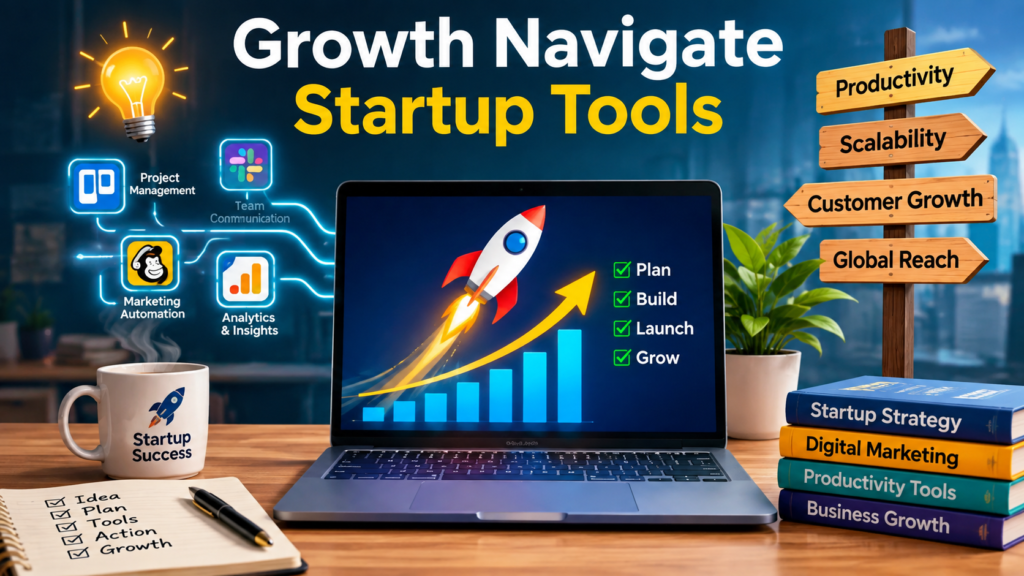
growth navigate startup tools
Finding the right technology can make a major difference when a startup is trying to move from an early idea to a sustainable business. However, the sheer number of platforms available today can make choosing the right solutions surprisingly difficult. This is where growth navigate startup tools can become useful for founders looking to organise their operations, understand customers and build predictable growth.
For a new business, technology should solve real problems rather than simply add another subscription. The best startup tools help teams save time, make informed decisions, communicate effectively and create repeatable processes. Whether a company is operating from London, Manchester, Birmingham or remotely across the UK, a focused technology stack can provide a strong foundation for growth.
What Are Growth Navigate Startup Tools?
Growth navigate startup tools refers to the collection of digital platforms and software solutions that help startups manage and accelerate different areas of business development. These tools can cover marketing, customer relationship management, project management, analytics, finance, communication and sales.
The objective is not to use as many tools as possible. Instead, founders should select technologies that support specific business goals. A small startup may only need a handful of carefully chosen platforms, while a growing company may require more specialised systems as its operations become complex.
Why Startup Tools Matter for Business Growth
Early-stage companies usually operate with limited budgets, small teams and restricted resources. Employees often perform several roles, meaning repetitive administrative work can quickly consume valuable time.
Effective startup software can automate routine activities and make information easier to access. A customer relationship management platform, for example, can help a sales team keep track of leads and customer interactions without relying on spreadsheets or scattered notes.
Technology can also improve decision-making. Analytics platforms provide insights into website traffic, customer behaviour and marketing performance, allowing founders to identify what is working and where resources may be wasted.
Customer Relationship Management Tools
Customer relationships are central to sustainable growth. CRM software helps businesses organise customer information, monitor prospects and manage communication throughout the sales process.
For startups, a simple CRM can be particularly valuable because it creates a central location for customer data. As the business expands, structured customer information can support better sales forecasting, personalised communication and customer retention.
Marketing and Content Tools
Marketing is another important area where digital tools can improve efficiency. Startups often need to produce content, manage social media, monitor campaigns and understand audience behaviour without having a large marketing department.
SEO platforms, email marketing software, social media management systems and content planning applications can help small teams maintain consistent marketing activity. The key is to connect these activities to measurable objectives rather than creating content simply for the sake of publishing.
Project Management Tools
As soon as more than one person becomes involved in a project, communication can become complicated. Project management software helps teams organise responsibilities, deadlines and ongoing work.
For remote and hybrid UK startups, these platforms can be particularly useful. Team members can see project progress without needing constant meetings, while managers can identify delays and adjust priorities more quickly.
Financial Management Tools
Cash flow is one of the most important concerns for any startup. Financial software can simplify invoicing, expense tracking, budgeting and financial reporting.
Using digital financial tools can also reduce manual administrative work. This gives founders more time to focus on customers, product development and strategic decisions while maintaining better visibility over business finances.
How to Choose the Right Startup Tools
The best growth navigate startup tools are not necessarily the most advanced or expensive options. A startup should first identify its biggest operational problems and then search for technology that directly addresses them.
Ease of use is also important. A powerful platform that employees rarely use provides little value. Startups should favour tools with intuitive interfaces, suitable pricing and features that match their current requirements.
Integration should also be considered. When marketing, sales, customer service and financial systems can exchange information efficiently, teams spend less time transferring data manually and are less likely to make mistakes.
Avoiding Tool Overload
One common mistake among growing startups is adopting too many platforms too quickly. Every new subscription introduces another system to learn, maintain and potentially integrate.
A large technology stack can create the opposite of productivity. Employees may waste time switching between applications, while important information becomes fragmented across multiple systems.
A better approach is to start with essential tools and expand the technology stack only when a genuine business requirement appears. Regularly reviewing software subscriptions can also help startups remove platforms that no longer provide sufficient value.
Using Startup Tools to Support Scalable Growth
Scalability means creating processes that can handle increasing demand without requiring the same increase in manual effort. Digital tools can support this by automating repetitive workflows and establishing consistent processes.
For example, automated email sequences can support lead nurturing, while project management systems can standardise internal workflows. Analytics tools can help management understand performance without manually compiling reports every week.
The most valuable systems therefore do more than save time. They create repeatable processes that allow a startup to grow while maintaining quality and customer experience.
Growth Navigate Startup Tools and the UK Market
UK startups operate within a competitive business environment where efficiency can have a significant impact. Businesses may serve local customers, national markets or international audiences from the same digital infrastructure.
For founders in the UK, selecting scalable technology can also make it easier to work with distributed teams and customers in different regions. Businesses should consider factors such as pricing, data protection, integration capabilities and customer support when evaluating software.
The right tools should fit the company’s business model rather than forcing the company to change its entire workflow around a particular platform.
Measuring Whether a Tool Is Worth Keeping
A startup should periodically evaluate whether its software is producing meaningful results. Cost alone is not enough to determine value.
A tool may justify its subscription if it saves employees significant time, increases qualified leads, improves customer retention or reduces operational errors. Conversely, a platform that receives little use may simply be adding unnecessary expense.
Tracking adoption and business outcomes makes it easier to decide which systems deserve continued investment.
Common Mistakes Startups Make With Digital Tools
Choosing software based purely on popularity can lead to poor decisions. A tool that works exceptionally well for a large company may be unnecessarily complicated for a five-person startup.
Another mistake is ignoring employee adoption. Successful implementation requires people to understand why a tool is being introduced and how it improves their work.
Startups should also avoid changing systems too frequently. Constantly moving customer data and workflows between platforms can disrupt operations and create additional costs.
The Future of Startup Growth Technology
Startup technology is becoming increasingly connected, automated and data-driven. Businesses can now manage many activities through cloud-based platforms that support collaboration from almost anywhere.
As technology develops, founders will have access to more sophisticated automation, analytics and workflow capabilities. However, the fundamental principle will remain the same: technology should support clear business objectives.
The strongest startups are unlikely to succeed simply because they use more software. They succeed because they use the right technology to solve meaningful customer and operational problems.
Conclusion
Growth navigate startup tools can provide an important foundation for businesses seeking efficient and sustainable growth. From CRM and marketing platforms to project management and financial software, the right systems can reduce manual work and give founders better control over their operations.
For UK startups, the smartest approach is to build a focused technology stack around genuine business needs. Start small, measure results and introduce additional tools only when they provide clear value. With the right strategy, technology becomes more than a collection of applications; it becomes part of the infrastructure that supports long-term business growth.
FAQs
What are growth navigate startup tools?
Growth navigate startup tools are digital solutions designed to help startups manage operations, marketing, sales, customers, finances and business growth more efficiently.
Why are startup tools important?
Startup tools can reduce repetitive work, improve organisation, support better decisions and help small teams operate more efficiently as the business grows.
Which startup tools should a new business use first?
A new business should prioritise tools that address immediate needs, such as customer management, communication, project organisation, accounting and marketing.
Are expensive startup tools always better?
No. The best growth navigate startup tools are those that solve specific business problems and provide measurable value. A simple, affordable platform can be more useful than an expensive system with unnecessary features.
How can startups avoid software overload?
Startups can avoid software overload by introducing tools gradually, reviewing subscriptions regularly and removing platforms that provide little value or have low adoption.
Can startup tools improve productivity?
Yes. Automation, centralised information and structured workflows can reduce administrative work and allow employees to spend more time on higher-value activities.
Should UK startups prioritise cloud-based tools?
Cloud-based tools can be useful because they support remote access, collaboration and flexible working. However, startups should still evaluate security, pricing and integration requirements before choosing a platform.
How often should startups review their software?
Startups should periodically review their technology stack to assess usage, costs, business results and whether each platform still meets current requirements.
What makes a startup tool scalable?
A scalable tool can continue supporting a business as its customer base, team and operational requirements increase without creating excessive manual work or requiring an immediate replacement.
What is the main benefit of growth navigate startup tools?
The main benefit is creating a more organised and efficient business infrastructure that helps founders focus on customers, strategy and sustainable growth rather than repetitive administration.