
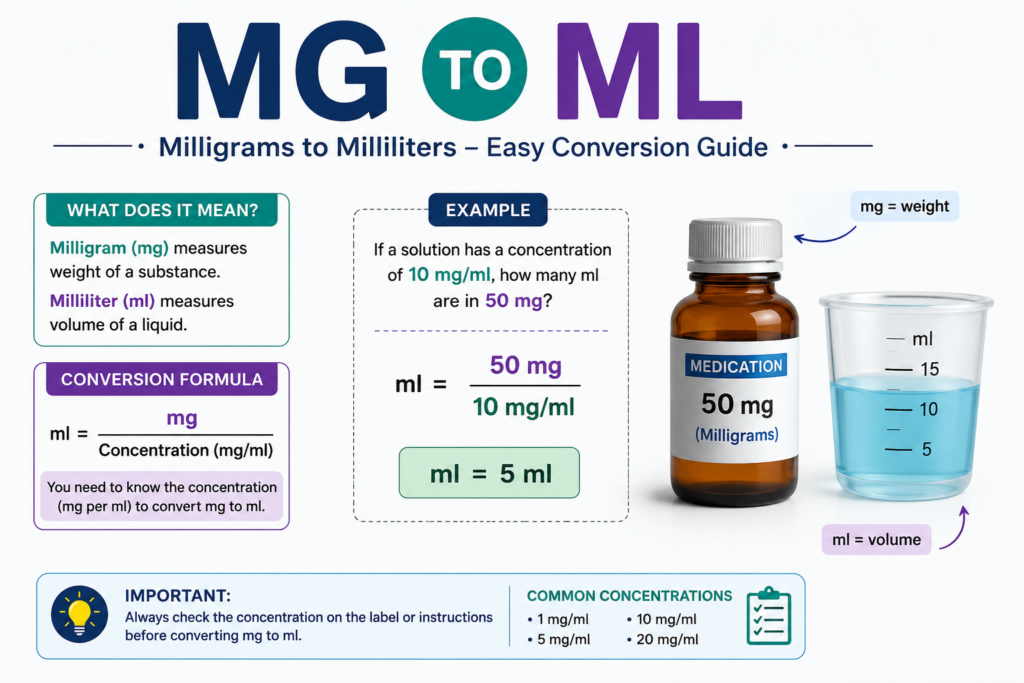
Easy guide for converting medicine doses accurately.
Have you ever looked at a medicine label and wondered how many milliliters you should measure after seeing the dose written in milligrams? You’re not alone. This is one of the most common questions people ask when using liquid medicines, preparing supplements, or working with recipes and laboratory solutions.
The important thing to know is that there is no single formula that converts milligrams directly into milliliters. The correct answer depends on the concentration of the liquid.
This guide explains everything in simple language, including the conversion formula, practical examples, a helpful table, and common mistakes to avoid.
What Does mg Mean?
Milligram (mg) is a unit of mass or weight.
- 1 gram = 1,000 milligrams
- Used for medications, vitamins, supplements, and chemicals
- Indicates how much of a substance is present
For example:
- A tablet may contain 500 mg of acetaminophen.
- A vitamin capsule may contain 250 mg of vitamin C.
Milligrams tell you the amount of the ingredient—not the volume.
What Does mL Mean?
Milliliter (mL) is a unit of volume.
It measures how much space a liquid occupies.
Examples include:
- Medicine syrups
- Water
- Cooking liquids
- Laboratory solutions
One milliliter equals one-thousandth of a liter.
Why You Can’t Convert Directly
Many people search for a simple conversion between milligrams and milliliters, but that isn’t possible without knowing the liquid’s concentration.
For example:
- Medicine A: 100 mg in 5 mL
- Medicine B: 100 mg in 10 mL
Both contain 100 mg, but the volume is completely different.
That is why concentration always matters.
The Conversion Formula
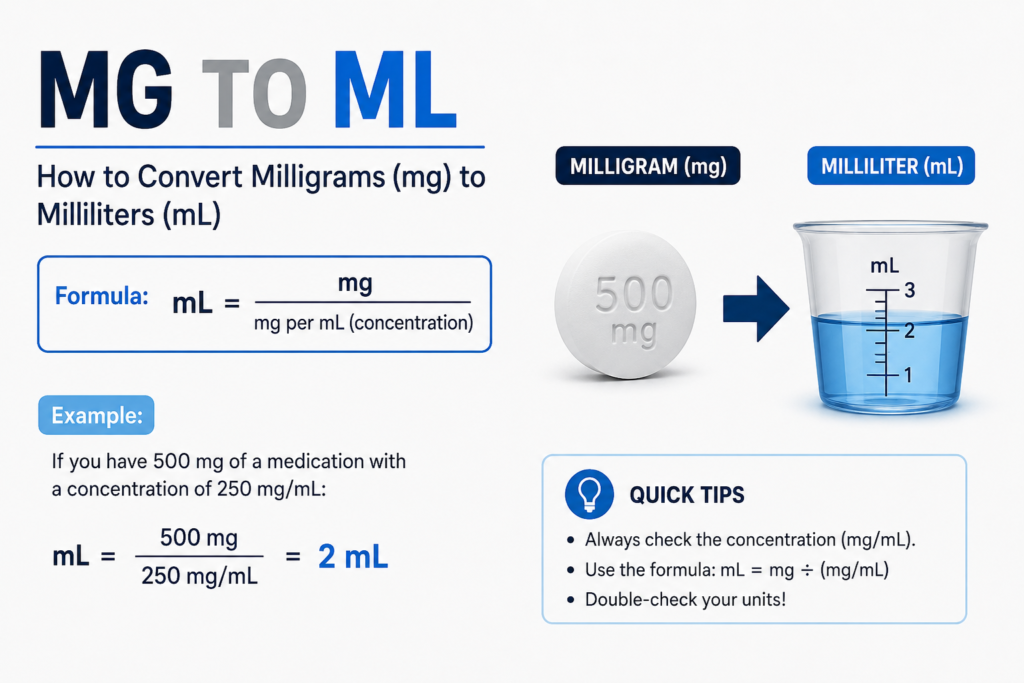
Use this formula:
| Formula | Meaning |
|---|---|
| mL = mg ÷ (mg per mL) | Divide the required dose by the concentration |
The concentration is usually printed on the label.
Examples:
- 250 mg/5 mL
- 100 mg/mL
- 500 mg/10 mL
Simple Examples
Example 1
Medicine strength:
250 mg in 5 mL
Required dose:
125 mg
Calculation:
125 ÷ 50 = 2.5 mL
Answer:
125 mg = 2.5 mL
Example 2
Concentration:
100 mg/mL
Required:
300 mg
Calculation:
300 ÷ 100 = 3 mL
Answer:
300 mg = 3 mL
Example 3
Strength:
500 mg in 10 mL
Dose:
250 mg
Calculation:
500 ÷ 10 = 50 mg per mL
250 ÷ 50 = 5 mL
Answer:
250 mg = 5 mL
Quick Conversion Table
| Concentration | 50 mg | 100 mg | 250 mg | 500 mg |
|---|---|---|---|---|
| 50 mg/mL | 1 mL | 2 mL | 5 mL | 10 mL |
| 100 mg/mL | 0.5 mL | 1 mL | 2.5 mL | 5 mL |
| 25 mg/mL | 2 mL | 4 mL | 10 mL | 20 mL |
This table is only valid for the listed concentrations.
Where This Conversion Is Used
Understanding this calculation is useful in many situations.
Medication
Doctors often prescribe medicine in milligrams, while bottles provide measurements in milliliters.
Children’s Medicine
Parents frequently need to measure liquid antibiotics or fever medicine accurately.
Vitamins
Liquid supplements often provide serving sizes in milliliters while listing nutrients in milligrams.
Veterinary Medicine
Pet medications also use concentrations that require conversion.
Laboratories
Scientists regularly calculate solution volumes based on concentration.
How to Read a Medicine Label
Suppose the label says:
Amoxicillin 400 mg/5 mL
This means:
- Every 5 mL contains 400 mg
- Every 1 mL contains 80 mg
If your doctor prescribes 200 mg:
200 ÷ 80 = 2.5 mL
You would measure 2.5 mL.
Common Mistakes
Avoid these errors:
- Assuming every medicine has the same concentration.
- Guessing instead of checking the label.
- Confusing milligrams with milliliters.
- Using kitchen spoons instead of measuring syringes.
- Ignoring decimal points.
Even small measuring mistakes can affect medication accuracy.
Helpful Tips
For safer measurements:
- Always read the medicine label carefully.
- Check the concentration before calculating.
- Use a medicine syringe or measuring cup.
- Double-check your math.
- Ask a pharmacist if you’re unsure.
Does Water Make the Conversion Easy?
People sometimes think water provides a universal conversion.
While 1 mL of water weighs approximately 1 gram (1,000 mg) under standard conditions, this relationship does not apply to medicines, syrups, oils, supplements, or chemical solutions because each liquid has its own density and concentration.
That’s why medication labels remain the safest source for accurate dosing.
Difference Between mg, mL, and mg/mL
| Unit | Measures | Example |
|---|---|---|
| mg | Mass | 250 mg medicine |
| mL | Volume | 5 mL syrup |
| mg/mL | Concentration | 50 mg per mL |
Understanding the difference prevents incorrect calculations.
When Should You Ask a Healthcare Professional?
You should seek professional advice if:
- The label is difficult to read.
- The concentration isn’t listed.
- Multiple strengths are available.
- You’re giving medicine to a child.
- The prescribed dose doesn’t match the bottle instructions.
Never guess medication doses.
Conclusion
Converting between milligrams and milliliters is simple once you understand one key rule: you must know the liquid’s concentration. Since milligrams measure mass and milliliters measure volume, there is no universal conversion. Always read the product label, use the correct formula, and measure carefully. Whether you’re using medication, supplements, or laboratory solutions, accuracy helps ensure safe and effective results.
FAQs
Can I convert milligrams directly into milliliters?
No. You need the liquid’s concentration, usually shown as mg per mL or mg per 5 mL.
Why are medicines labeled in both units?
Milligrams show the amount of active ingredient, while milliliters show the volume you need to measure.
Is 500 mg always equal to 5 mL?
No. It depends entirely on the concentration of the liquid.
What is the safest way to measure liquid medicine?
Use the measuring syringe or cup supplied with the medicine. Avoid using household teaspoons.
Can different medicines have the same milligram dose but different milliliter amounts?
Yes. Different products often have different concentrations, so the required volume may vary.
For more updates visit: Hiding Me